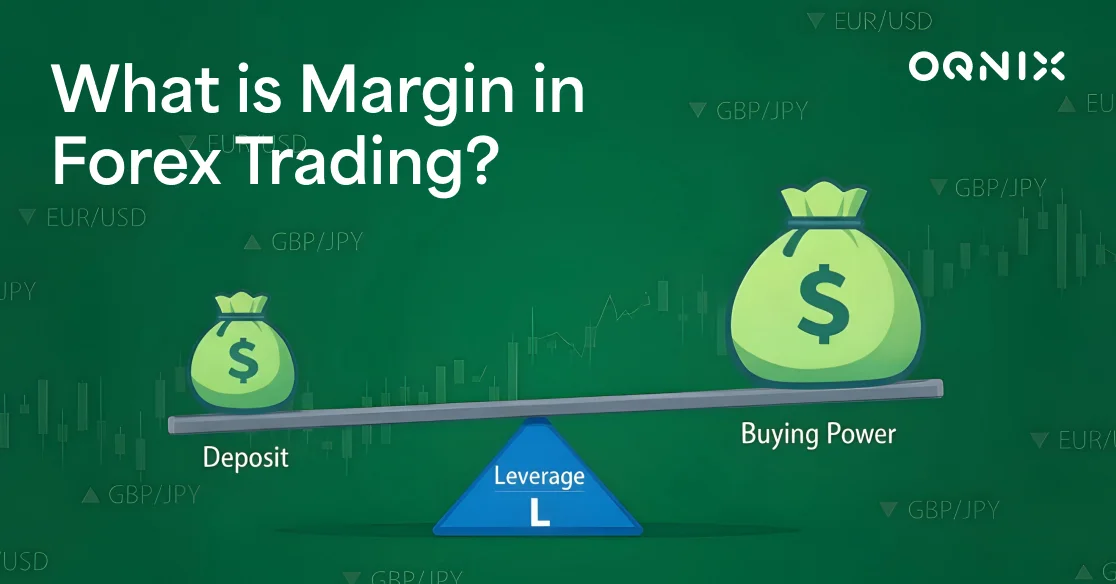
What is margin in forex trading?
Margin in forex trading is the minimum amount of money your broker requires you to deposit in order to open and hold a trade. It’s not a fee — it’s a security deposit that unlocks leverage, letting you control a much larger position than your own capital alone would allow.
Let’s Start with the Basics — What Exactly Is Margin?
If you’ve just started exploring forex, you’ve probably come across the word “margin” and thought — What does that even mean?
Here’s the simplest way to think about it.
Imagine you want to rent a high-end car worth $50,000. The rental company doesn’t ask you to pay the full $50,000. Instead, they ask for a refundable security deposit — say $500 — just to show you’re serious.
Forex margin works the same way. Your broker lets you control a large currency position, but asks you to put up a small deposit as security. That deposit is your margin.
It’s not money you’re spending. It’s money being held while your trade is open. Once you close the trade, that margin is released back into your account.
How Does Margin Work in Forex? (The Real Explanation)
Here’s where most beginner guides get too technical. Let’s keep it grounded.
When you open a forex trade, you’re essentially borrowing money from your broker to control a bigger position. This borrowed amplification is called leverage. Margin is what makes leverage possible.
Your broker expresses the margin requirement as a percentage of the total trade value.
For example:
- You want to open a trade worth $100,000 (one standard lot of EUR/USD)
- Your broker’s margin requirement is 1%
- So you only need to deposit $1,000 to open that trade
- Your broker covers the remaining $99,000
That $1,000 is your margin. Simple.
The leverage here is 100:1 — because you’re controlling 100x your actual deposit.
The Relationship Between Margin and Leverage
These two always go hand in hand. If you understand one, the other makes instant sense:
| Leverage Ratio | Margin Required |
|---|---|
| 10:1 | 10% |
| 50:1 | 2% |
| 100:1 | 1% |
| 200:1 | 0.5% |
Higher leverage = smaller margin needed. Lower leverage = more of your own money required.
Key Margin Terms You Must Know
Before going further, let’s decode the four terms you’ll see on every trading platform. Don’t skip this — they matter a lot in size.
1. Required Margin (or Used Margin)
This is the amount your broker locks aside when you open a trade. It’s not available for other trades until you close the current one.
2. Free Margin
This is the money left in your account that isn’t being used. You can use free margin to open new trades or absorb any losses on current ones.
Free Margin = Equity − Used Margin
3. Equity
Your equity is your account balance plus or minus any open profit or loss. It changes in real-time as market prices move.
4. Margin Level
This is your account’s health indicator — shown as a percentage.
Margin Level = (Equity ÷ Used Margin) × 100
A margin level of 200% or above is generally considered safe. Below 100%? You’re entering danger territory.
A Real-Life Margin Example (Step by Step)
Let’s say your trading account has $2,000 and you want to trade EUR/USD.
Step 1: You decide to open a trade worth $100,000 (1 standard lot).
Step 2: Your broker requires 1% margin — so $1,000 is locked as used margin.
Step 3: Your free margin is now $1,000 (the remaining $2,000 − $1,000).
Step 4: Your margin level = (2,000 ÷ 1,000) × 100 = 200% — healthy.
Now, the market moves against you. Your account equity drops to $1,000.
Your margin level is now = (1,000 ÷ 1,000) × 100 = 100% — warning zone.
If it drops further to, say, 50%, your broker might automatically close your trade. That’s called a stop-out.
What Is a Margin Call — and Why Should You Fear It?
A margin call is your broker’s way of saying: “Your account is running low. Do something — now.”
It happens when your margin level falls below a certain threshold (usually around 100%, though it varies by broker). At this point, you have two options:
- Deposit more funds to bring your margin level back up
- Close some open trades to free up used margin
If you ignore the margin call and losses continue, your broker won’t wait forever. Once the margin level hits the stop-out level (often 50%), they’ll begin automatically closing your positions — starting with the most unprofitable ones.
This isn’t punishment. It’s your broker protecting both of you from unlimited losses.
The hard truth: Most traders who blow their accounts do so because they ignored their margin level until it was too late.
How to Calculate Margin in Forex (The Easy Formula)
You don’t need to be a math genius. Here’s the formula:
Required Margin = Trade Size ÷ Leverage
Example 1:
- Trade size: $50,000
- Leverage: 50:1
- Required Margin = $50,000 ÷ 50 = $1,000
Example 2 (with exchange rate):
- You’re trading 1 lot of EUR/USD at 1.1200
- Position value = 100,000 × 1.1200 = $112,000
- At 100:1 leverage, Required Margin = $112,000 ÷ 100 = $1,120
Most trading platforms calculate this automatically. But understanding the formula helps you plan trades before you enter them — which is a habit of disciplined traders.
Benefits of Trading on Margin
Used properly, margin isn’t the villain. Here’s what it genuinely offers:
Access to Bigger Markets Without margin, most retail traders couldn’t participate meaningfully in forex. Margin democratises access to the $7.5 trillion-a-day currency market.
Capital Efficiency Instead of tying up $100,000 in one trade, you use $1,000 and keep the rest available. This lets you diversify across multiple positions.
Amplified Returns on Small Moves. Forex prices typically move in fractions of a cent. Leverage (powered by margin) turns those tiny moves into meaningful profits.
Flexibility Across Strategies Whether you’re a scalper, day trader, or swing trader, margin-based leverage supports all styles of trading.
The Real Risks of Margin Trading (Don’t Skip This)
It would be dishonest not to talk about this clearly. Margin is powerful — which means it can work powerfully against you, too.
Losses Are Magnified. Just as a 1% price move can double your money with high leverage, it can also wipe it out. Your loss is calculated on the full position size, not just your margin deposit.
Margin Calls Can Happen Fast In volatile markets — like during major news events — prices can spike dramatically within seconds. Your margin level can collapse before you even have time to react.
Psychological Pressure Watching your equity swing rapidly while you have large leveraged positions open is genuinely stressful. Many traders make impulsive decisions under this pressure that they later regret.
Overnight Costs Leveraged positions held past daily market close incur swap fees (rollover charges). Over time, these can quietly eat into your returns.
6-Step Guide to Using Margin Safely
Here’s a practical framework you can apply from your very first trade:
Step 1: Know Your Broker’s Margin Rules Before placing any trade, check what margin percentage your broker requires for the pair you’re trading. This varies by currency pair and broker.
Step 2: Calculate Your Required Margin Before Entering Use the formula above or your platform’s built-in calculator. Never open a position without knowing how much margin it will consume.
Step 3: Keep Your Margin Level Above 200% This gives you a safety buffer. If the market moves against you, you have room to breathe rather than immediately facing a margin call.
Step 4: Always Set a Stop-Loss This is non-negotiable. A stop-loss closes your trade automatically if price moves against you beyond a limit you set. It protects your margin from being fully eroded.
Step 5: Never Use All Your Free Margin Leaving some free margin in your account is like keeping an emergency fund. It protects you from sudden market spikes.
Step 6: Start with Lower Leverage 10:1 or 20:1 leverage is far safer for beginners than jumping straight to 100:1. The profits may be smaller, but so are the losses — and staying in the game is the goal.
Expert Tips from Experienced Forex Traders
A few insights that take most traders years to learn — you’re getting them now:
If you’re confused about your margin level, check your platform dashboard. MetaTrader and most modern platforms show used margin, free margin, and margin level in real-time.
“Your margin level is your trading health score.” Check it constantly, not just when you open a trade.
Treat your margin as real money. It is. The fact that it’s a “deposit” doesn’t make it disposable.
Lower leverage is a strength, not a weakness. Professionals routinely use 5:1 to 20:1 even when 500:1 is available.
On high-volatility days, reduce your position size. Central bank announcements, NFP data releases, and geopolitical events can move markets erratically.
Frequently Asked Questions (FAQs)
Q1: Is forex margin the same as a fee?
No — margin is not a fee or a cost. It’s a refundable deposit held by your broker while your trade is open. Once you close the trade, that margin is returned to your account balance (adjusted for any profits or losses).
Q2: What happens if I don’t meet a margin call?
If you receive a margin call and don’t act — either by depositing more funds or closing trades — your broker will step in. Once your margin level hits the stop-out threshold (often 50%), they’ll automatically close your open positions to prevent further losses.
Q3: What is a good margin level to maintain in forex?
Most experienced traders aim to keep their margin level above 200%. This provides a comfortable buffer against market volatility. Anything below 150% should prompt you to review your open positions carefully.
Q4: Can I trade forex without using margin?
Technically yes — if you use 1:1 leverage, you’re trading only with your own capital and margin isn’t a factor. However, the vast majority of forex trading happens with leverage, making margin an essential concept for any active trader to understand.
Q5: Does the margin requirement vary between currency pairs?
Yes, absolutely. Major Currency pairs like EUR/USD or GBP/USD typically carry lower margin requirements because they’re highly liquid and less volatile. Exotic pairs like USD/ZAR or USD/TRY often require more margin because of higher volatility and lower liquidity.
Q6: How much margin should a beginner use?
Start conservatively. With a $1,000 account, using 10:1 leverage means your margin controls $10,000 in trades — manageable risk. Avoid using more than 20–30% of your total account balance as used margin at any one time. The more room you leave, the longer you survive learning.
Conclusion: Margin Is a Tool — Use It Like One
Margin in forex trading isn’t something to fear. But it absolutely demands respect.
When you understand how margin works — how it connects to leverage, equity, and margin level — you stop trading blindly and start trading with intention. You know how much you’re risking. You know when to step back. And you know how to stay in the game long enough, actually, to get good at it.
The traders who struggle with margin are usually those who rush in with maximum leverage and no risk plan. The ones who succeed treat margin as a precision tool: useful, but handled carefully.


